
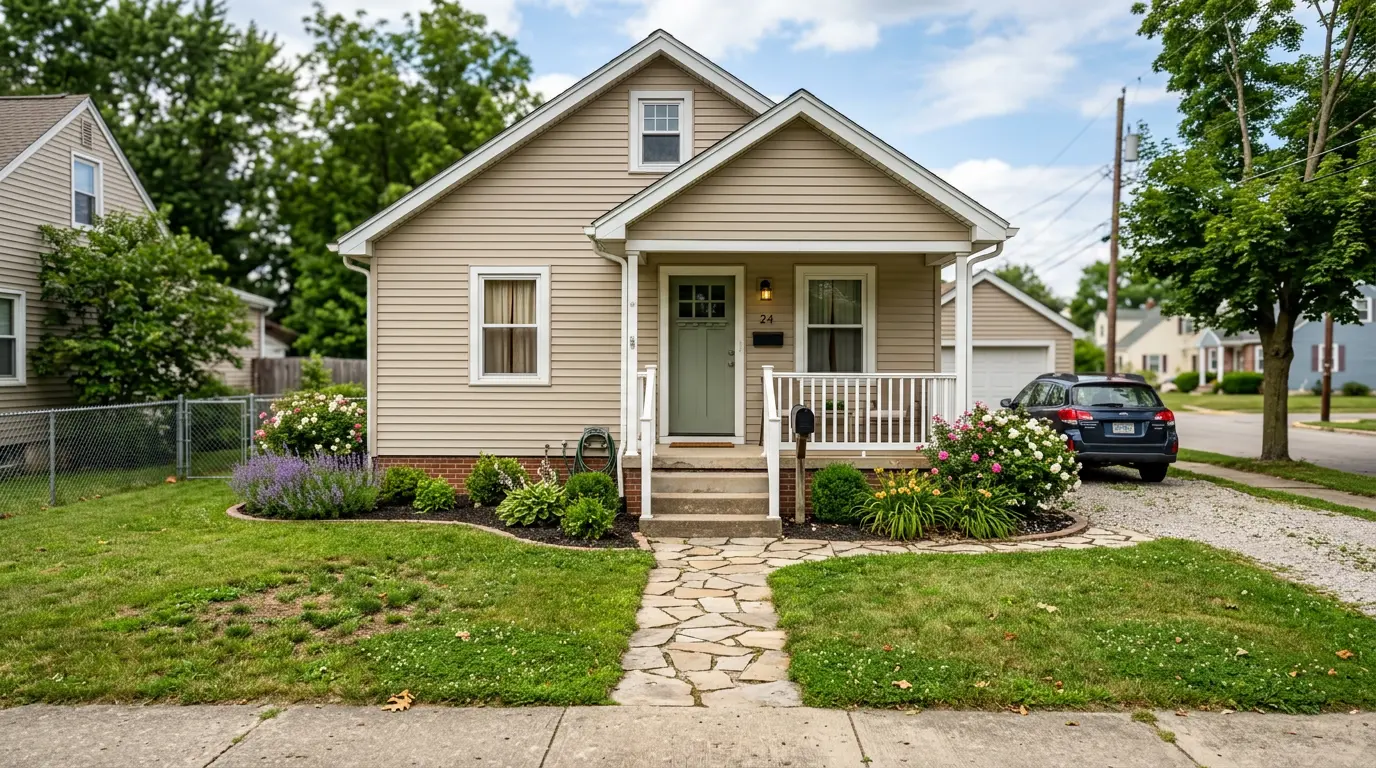
Front Yard Landscaping Ideas – Transform Your Curb Appeal
Front Yard Landscaping Ideas That Will Transform Your Home’s Curb Appeal
A complete guide to designing, planting, and maintaining a front yard that welcomes, impresses, and endures — season after season.
There is a particular kind of quiet joy that arrives the moment you step back from your front yard after a full morning of planting — hands still carrying the warm, loamy perfume of freshly turned earth, eyes tracing the gentle arcs of new borders, the promise of colour held in every unopened bud. That joy is available to every homeowner, not just those with landscape-architecture degrees or limitless budgets. What it takes is a clear vision, a little patience, and the right ideas to guide you forward.
Your front yard is the very first chapter of the story your home tells the world. Before a guest ever rings your doorbell, before a neighbour glances over the fence, the landscape speaks — about your taste, your care, your relationship with the natural world. Whether your plot is a modest strip of lawn in a suburban row, a generous sun-soaked expanse, or a shadowy urban patch dominated by a single mature tree, the potential to create something truly beautiful is always there, waiting beneath the surface. This guide exists to help you find it, shape it, and sustain it across every season of the year.
Table of Contents
Why Front Yard Landscaping Ideas Matter More Than You Think
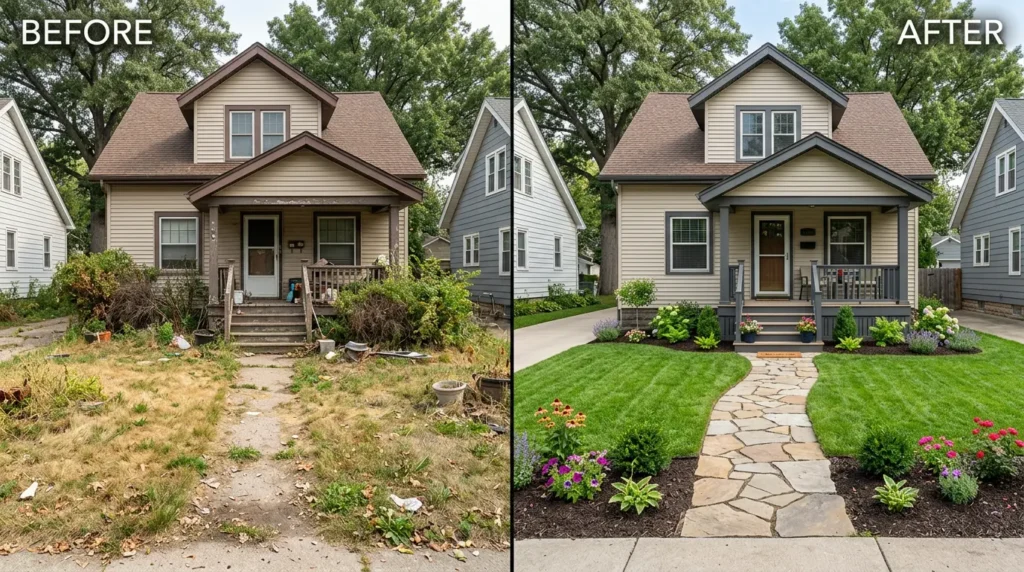
Most homeowners underestimate the power of a well-considered front yard, treating it as an afterthought — a patch of grass to mow on weekends and little more. But research consistently tells a different story. Studies from the University of Michigan have shown that strategic landscaping can increase a property’s market value by as much as 12 to 15 percent, a return that rivals kitchen renovations costing far more in both time and money. Beyond the financial dimension, a beautiful front yard improves neighbourhood cohesion, contributes measurably to local biodiversity, and — perhaps most importantly — delivers the kind of daily, gentle pleasure that feeds the soul in ways that are difficult to quantify but impossible to ignore.
The true magic of thoughtful front yard landscaping lies in its layered nature: every decision you make, from the species of ground cover you choose to the colour of your edging stones, compounds with every other decision to create a living composition that is simultaneously practical and poetic. Understanding this layered logic before you begin is the single most important step you can take, because it transforms your approach from reactive — filling in bare patches, managing weeds — to intentional, which is where genuine beauty begins.
A front yard is not merely a strip of land between your door and the street — it is a first impression, a habitat, a seasonal poem written in soil, root, and petal.
Foundational Design Principles for Stunning Front Yard Landscaping
The Rule of Threes and Visual Rhythm
Professional landscape designers frequently invoke what they call the “rule of threes,” a compositional principle borrowed from fine art that suggests grouping plants, features, and colours in odd numbers creates a more dynamic, natural-looking arrangement than symmetrical pairs or even-numbered clusters. When you plant three ornamental grasses of varying heights — a tall Miscanthus sinensis at the back, a mid-height Pennisetum alopecuroides in the middle, and a compact Festuca glauca at the front — your eye moves through the composition rather than resting flatly upon it, creating what designers call visual rhythm. This same principle applies to the placement of garden ornaments, stepping stones, and flowering perennials.
Layering: The Canopy, Understory, and Ground Plane
The most naturalistic and maintenance-efficient front yards are those that replicate the structure of a natural woodland or meadow by working in three distinct layers. The canopy layer consists of any trees or large shrubs that provide overhead structure and shade — a Cercis canadensis (Eastern Redbud) or a well-placed Amelanchier (Serviceberry) can anchor an entire design while providing spring blossom, summer shade, autumn colour, and wildlife habitat across all four seasons. The understory layer is populated by medium shrubs and larger perennials, which provide the visual bulk and flowering interest for most of the year. The ground plane layer — ground covers, low-growing perennials, mulch, and edge plants — ties everything together and, critically, suppresses the weeds that would otherwise fill any unclaimed soil.
Colour Theory in the Garden
Colour is perhaps the most emotionally immediate element in any landscape, capable of making a space feel larger or smaller, warmer or cooler, more formal or more relaxed. Warm colours — the reds, oranges, and golds of Helenium, Rudbeckia, and Crocosmia — advance visually, making them ideal for drawing attention to a focal point like an entryway or a statement specimen plant. Cool colours — the blues, purples, and silvers of Agapanthus, Salvia nemorosa, and Stachys byzantina — recede, creating depth and a sense of calm that works beautifully in narrow front yards where you want the space to feel more expansive than it is.
Sunlight Requirements by Plant Category
| Plant / Category | Light Requirement | Hours of Direct Sun | Best Placement |
|---|---|---|---|
| Lavender, Salvia, Echinacea | Full Sun | 6 – 8 hrs / day | Open south or west-facing borders |
| Hydrangea, Astilbe, Coral Bells | Part Shade | 3 – 6 hrs / day | Dappled areas under tree canopies |
| Hostas, Ferns, Bleeding Heart | Full Shade | 0 – 3 hrs / day | North-facing beds, deep shade areas |
| Ornamental Grasses, Sedum | Full Sun | 6+ hrs / day | Dry, exposed slopes or open lawn edges |
| Serviceberry, Redbud | Part Sun/Shade | 4 – 6 hrs / day | Near foundations, entry focal points |
| Boxwood, Holly, Yew | Part Shade | 3 – 5 hrs / day | Foundation plantings, formal hedges |
Soil Preparation: The Foundation Every Great Front Yard Landscape Needs
It is an axiom among experienced gardeners that you should spend as much time improving your soil as you spend choosing your plants, because a spectacular specimen in poor soil will always be outperformed by an ordinary plant in excellent soil. The soil is the engine of your garden, the invisible infrastructure upon which everything visible depends, and neglecting it is the single most common mistake that separates a thriving landscape from a struggling one.
For more detailed soil improvement techniques, you can explore this comprehensive guide from the Royal Horticultural Society.
Understanding Your Soil Type
Before you amend or plant anything, you need to know what you are working with. The three primary soil types — sandy, clay, and loam — behave in fundamentally different ways. Sandy soil drains rapidly and warms up quickly in spring, which sounds appealing until you realise that it also leaches nutrients at an alarming rate, leaving plants perpetually hungry despite your best fertilising efforts. Clay soil, by contrast, is nutrient-rich and moisture-retentive, but its dense, compaction-prone structure can suffocate roots and create the waterlogged conditions that invite fungal disease and root rot. Loam — the dark, crumbly, pleasantly earthy-smelling ideal — holds moisture without becoming waterlogged, drains without drying, and supports the microbial life that converts organic matter into plant-available nutrients. Most front yards sit somewhere on the continuum between these extremes, and understanding where yours falls is the first step toward improving it.
Expert Tip
A simple jar test reveals your soil type in 24 hours: fill a jar ⅔ with water, add a handful of soil, shake vigorously, then let it settle overnight. Sand sinks first (bottom layer), silt settles in the middle, and clay remains suspended near the top. The proportions of each layer tell you exactly what you are working with — no laboratory required.
Amending and Enriching Your Soil
Regardless of your starting soil type, the universal soil amendment that improves almost every garden situation is well-aged organic matter — compost, leaf mould, or well-rotted manure — worked to a depth of at least 30 centimetres (12 inches) before planting. For clay soils, this organic matter physically separates the dense clay particles, creating the air pockets that roots need to breathe and the drainage channels that prevent waterlogging. For sandy soils, the organic matter acts like a sponge, holding both water and nutrients in the root zone for far longer. For already-decent loamy soils, it simply continues the cycle of enrichment that sustains long-term fertility without synthetic inputs.
pH matters enormously and is frequently overlooked by beginning gardeners who focus exclusively on nutrient content. Most common landscape plants thrive at a pH between 6.0 and 7.0 (slightly acidic to neutral), but acid-loving plants like Rhododendrons, Azaleas, and Blueberries require a pH of 4.5 to 6.0, while lavender, sage, and many drought-tolerant Mediterranean plants prefer the alkaline side of the scale around 7.0 to 7.5. A basic pH test kit from any garden centre costs just a few dollars and will tell you whether your soil needs sulphur to acidify or agricultural lime to sweeten — information that can make the difference between a plant that thrives and one that slowly deteriorates despite every other measure of good care.
Planting Techniques That Give Your Front Yard Landscaping Ideas the Best Start
Timing Your Planting for Maximum Success
The question of when to plant is as important as the question of what to plant, yet it receives far less attention in most beginner gardening conversations. The foundational principle is straightforward: you want to give your plants the longest possible establishment period before they face their first real stress event, whether that is a summer drought, a winter freeze, or a late-spring dry wind. For most perennials, shrubs, and trees in temperate climates, this means that autumn planting — from early September through to the first hard frost — is vastly superior to spring planting. Cooler air temperatures reduce transpiration stress on the plant while the still-warm soil encourages vigorous root development, meaning that by the time the following spring arrives, an autumn-planted specimen has already established a substantial root system and is ready to explode into growth rather than spending its first season merely trying to survive.
Research-backed irrigation practices from University of California Agriculture and Natural Resources highlight the importance of deep watering.
Correct Planting Depth and Spacing
One of the most damaging — and most common — planting mistakes is burying the crown of a plant too deeply, a problem that is particularly acute with trees and shrubs. The root flare, which is the widening point at the base of the trunk where the roots begin to spread, should always sit at or very slightly above the finished soil level. When trees are planted too deeply, the bark at the base remains perpetually moist, creating the ideal conditions for the fungal pathogens that cause basal rots and canker diseases, which can kill even a mature tree over the course of several seasons. A useful rule of thumb is to plant slightly shallow rather than deep — it is always easy to mound a little more soil around the base of a plant if needed, but correcting a too-deep planting requires the traumatic process of digging the entire plant back up.
Spacing is the other dimension that beginning gardeners consistently underestimate, because they plant for the present appearance of their garden rather than its eventual reality. That attractive little Viburnum in a three-litre pot looks perfectly sized at 60 centimetres apart, but three years later, when it has reached its mature spread of two and a half metres, those same plants will be engaged in a sprawling, competitive tangle that reduces airflow, promotes disease, and forces you into the frustrating and time-consuming cycle of constant remedial pruning. Always plant to the mature size given on the label, resist the temptation to fill gaps immediately, and use annual bedding plants or spreading ground covers as temporary gap-fillers while your permanent plants establish.
🪴 Planting Checklist
Before lowering any plant into a hole, run through this sequence: 1) water the plant thoroughly in its pot at least two hours before planting; 2) dig the hole twice as wide as the root ball but only as deep; 3) roughen the sides of the hole with a fork to prevent a “pot effect”; 4) check the planting depth before backfilling; 5) firm gently — never stamp — the soil around the roots; 6) water deeply and immediately; 7) apply a 5–8 cm mulch ring, keeping it 10 cm clear of stems.
Watering Schedules and Irrigation Strategies for a Thriving Front Yard
Water is the element that gardeners most frequently get wrong — either providing too much of it in short, frequent bursts that encourage shallow rooting and fungal problems, or neglecting it until the visual signs of stress are already irreversible. The guiding principle of intelligent garden watering is deep and infrequent, a rhythm that drives plant roots downward in search of moisture, creating the deep, drought-tolerant root systems that allow a garden to withstand hot, dry periods with minimal intervention from the gardener.
The Deep Watering Method
A single deep watering — one that moistens the soil to a depth of 30–45 centimetres — is far more valuable than three or four light sprinklings that dampen only the top few centimetres. When the upper soil profile is kept consistently moist by frequent shallow watering, roots have no incentive to explore deeper, cooler, more reliably moist soil layers, and the result is a garden that becomes progressively more dependent on the gardener rather than less. Deep watering, delivered slowly enough for the water to infiltrate rather than run off, trains roots to follow moisture downward, building resilience with every season that passes.
Watering Frequency by Plant Type and Season
| Plant Type | Spring | Summer | Autumn | Winter |
|---|---|---|---|---|
| Newly planted trees & shrubs | 2× / week | 3× / week | 1× / week | Every 2–3 weeks (if dry) |
| Established perennials | 1× / week | 2× / week | 1× / 10 days | Minimal / rain-fed |
| Annuals & bedding plants | 2× / week | Daily – every other day | 2× / week | N/A (not in ground) |
| Ornamental grasses | 1× / week | 1× / week | Once established: rain-fed | None needed |
| Drought-tolerant plants (Lavender, Sedum, Agave) | Every 2 weeks | 1× / week | Every 3 weeks | None needed |
| Lawn areas | 1× / week | 2–3× / week | 1× / week | None needed |
Irrigation Systems Worth the Investment
For larger front yards or for gardeners who want to remove the uncertainty from watering entirely, a properly designed drip irrigation system connected to a programmable timer is one of the most valuable investments you can make. Drip irrigation delivers water slowly and directly to the root zone of each plant, eliminating the evaporation losses and fungal-disease risks associated with overhead sprinkler systems, while a timer ensures that the deep-and-infrequent watering rhythm is maintained automatically, even during summer holidays or prolonged periods of dry weather. Modern smart irrigation controllers can even connect to local weather data, skipping scheduled watering cycles when rain is forecast — a feature that typically reduces overall garden water usage by 30 to 50 percent compared with fixed-schedule systems.
Seasonal Care Tips to Keep Your Front Yard Landscaping Beautiful Year-Round
Complete Seasonal Care Calendar
| Season | Key Tasks | What to Plant | What to Avoid |
|---|---|---|---|
| Spring (Mar–May) | Cut back ornamental grasses; divide overcrowded perennials; apply pre-emergent weed control; top-dress beds with compost | Bare-root roses, perennials from pots, cool-season annuals (Violas, Pansies) | Planting tender perennials before last frost; over-pruning spring-flowering shrubs |
| Summer (Jun–Aug) | Deadhead spent flowers; deep water 2× /week; apply 2nd round of slow-release fertilizer; monitor for pests | Warm-season annuals (Zinnias, Marigolds); container plantings | Watering foliage in the evening; heavy pruning of trees (heat stress) |
| Autumn (Sep–Nov) | Plant spring bulbs; transplant or divide perennials; cut back diseased foliage; apply mulch before frost | Spring bulbs (Tulips, Daffodils, Alliums); trees and shrubs (best planting season) | Fertilising after mid-September; removing all seed heads (birds need food sources) |
| Winter (Dec–Feb) | Protect tender plants with fleece or straw; plan and order next year’s plants; prune dormant trees; check/repair irrigation | Bare-root trees, roses, and hedging (mild regions only) | Walking on frozen lawns; pruning frost-tender shrubs; aggressive soil disturbance |
The Art of the Winter Garden
Most gardeners think of winter as a period of garden death, an unfortunate dormancy to be endured until spring’s resurrection. But the most beautiful front yards are those designed to offer something of interest in every season, including the cold months when the bare bones of the landscape are most clearly revealed. Structural plants — the clipped topiary spheres of box or yew, the dramatic silhouettes of multi-stemmed Cornus and Betula, the persistent seed heads of Echinacea purpurea and Rudbeckia fulgida frosted silver by a January morning — create a winter garden that is not merely surviving but actively performing, its spare, graphic beauty carrying a different but equally valid kind of loveliness to the lush abundance of summer.
Fertilizing Your Front Yard: A Science-Based Approach to Plant Nutrition
Understanding N-P-K and What Your Plants Actually Need
Every bag of fertilizer carries a three-number code — say, 10-10-10 or 5-10-5 — that corresponds to the percentage by weight of nitrogen (N), phosphorus (P), and potassium (K), the three macronutrients that plants require in the largest quantities. Nitrogen drives leafy, vegetative growth and gives foliage its rich green colour; it is the nutrient most rapidly depleted from soil and the one most commonly deficient in gardens. Phosphorus supports root development, flowering, and fruit set, which is why phosphorus-rich fertilizers are recommended for newly planted specimens that need to establish their root systems quickly. Potassium — often called potash — governs overall plant health and resilience, strengthening cell walls, regulating water uptake, and improving resistance to pest, disease, and environmental stress.
Fertilizer Types, Timing & Application Rates
| Fertilizer Type | N-P-K | Best For | When to Apply | Application Rate |
|---|---|---|---|---|
| Balanced granular (slow-release) | 10-10-10 | General beds, established shrubs | Early spring; repeat mid-summer | 85–115 g / m² |
| Rose & flowering plant | 5-10-5 | Roses, perennials, annuals | After first flush; every 6 weeks | 70 g / m² |
| Lawn fertilizer (high-N) | 30-0-4 | Lawn areas | Spring + late summer; NOT autumn | Per label / spreader setting |
| Ericaceous (acid) | 17-6-6 | Rhododendrons, Azaleas, Blueberries | Spring only; avoid after July | 50 g / m² |
| Liquid seaweed | Variable / trace minerals | Stress recovery, transplants | Fortnightly during growing season | Per label / dilution |
| Well-rotted compost | Varies (~1-1-1) | All garden areas | Autumn mulch or spring top-dress | 5–8 cm layer over beds |
Popular Front Yard Landscaping Ideas for Every Style and Budget
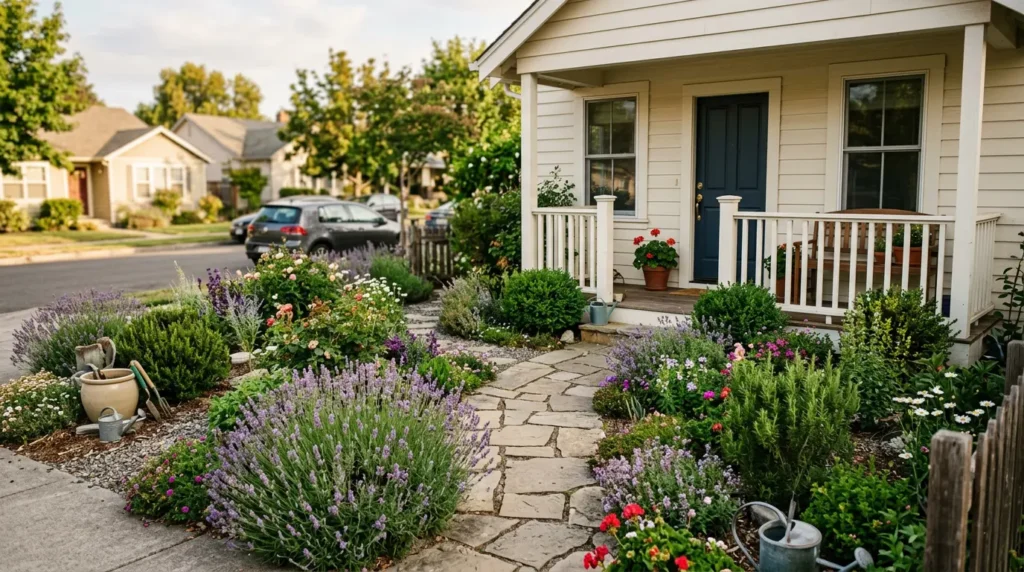
The Cottage Garden Front Yard
The cottage garden aesthetic — its seemingly artless abundance of Digitalis, Nepeta, antique roses, and sweet-scented Phlox spilling over a meandering path — is perhaps the most beloved front yard style in the English-speaking world, and for good reason. It projects warmth, welcome, and a kind of cheerful generosity that makes every visitor feel immediately at ease, while its dense, multi-layered planting suppresses weeds so effectively that, paradoxically, it often requires less maintenance than a conventional lawn-and-border scheme once it is properly established. The key to success with the cottage garden front yard is to choose a restricted palette of three to five colours and allow the plants to find their own natural arrangement over time, editing and moving only those combinations that genuinely do not work.
The Low-Maintenance Drought-Tolerant Front Yard
With summer droughts becoming longer and more intense across many regions, and with water bills rising accordingly, the drought-tolerant or “xeriscape” front yard has moved from a niche environmental choice to a genuinely practical one for a growing number of homeowners. The foundational principle of xeriscape design is to choose plants that are adapted to the rainfall patterns of your climate, rather than plants that require supplemental irrigation throughout the summer growing season. In practice, this means leaning heavily on Mediterranean herbs like lavender, rosemary, and sage; drought-resistant ornamental grasses such as Stipa tenuissima and Festuca mairei; and structural succulents like Agave, Yucca, and the many species of Sedum that thrive on neglect and reward it with extraordinary textural beauty.
The Native Plant Front Yard
Growing interest in ecological gardening has driven a quiet revolution in front yard design, as more and more homeowners choose to replace their water- and chemical-intensive traditional lawns with plant communities that reflect and support the native ecology of their region. A native plant front yard, thoughtfully designed, does not look wild or neglected — it can be just as polished and structured as any conventional design, while providing the kind of deep ecological value that a monoculture lawn simply cannot. Native plants require no fertilising, minimal watering once established, and no pesticides, because they have co-evolved over thousands of years with the soils, rainfall patterns, and temperature extremes of your specific region. More importantly, they provide the specific foliage, pollen, nectar, and nesting habitats that local insects, birds, and small mammals depend upon — an ecological contribution of enormous value at a time when native habitat continues to diminish.
The Formal Structured Front Yard
For those whose homes have a traditional architectural character — Georgian symmetry, Victorian grandeur, Edwardian propriety — the formal structured front yard provides a fitting setting that honours the building’s lines without competing with them. The vocabulary of formal design is composed of clipped hedges, topiary standards, symmetrically arranged borders, and hard-paved pathways, all arranged according to axes of symmetry that extend from the central features of the house facade. Executed well, the formal front yard has an almost architectural quality, its geometric precision and evergreen permanence providing a year-round beauty that changes only subtly with the seasons, making it one of the most visually consistent approaches available to the landscaping designer.
Common Front Yard Landscaping Mistakes — and How to Avoid Every One of Them
Ignoring Scale and Proportion
The most persistent mistake in front yard landscaping is the selection of plants that are fundamentally wrong for the scale of the space in which they are placed. A Leyland cypress planted at the corner of a modest semi-detached house may seem like an elegant choice at the time of planting, when it stands barely a metre tall, but within a decade it will have grown into a looming, light-stealing monster that dwarfs the house, overwhelms the garden, and creates the kind of neighbourhood tension that ends friendships. Always research the ultimate height and spread of every plant you choose before purchasing — not the size it is when you buy it from the garden centre, but the size it will be in fifteen or twenty years — and make your decisions accordingly.
Planting in the Wrong Conditions
Every plant label carries light and soil requirement information for a reason, and ignoring that information in favour of the aesthetic you want to achieve is a recipe for disappointment. Placing a sun-loving lavender in the deep shade of a north-facing wall, or trying to grow an acid-loving Rhododendron in chalky alkaline soil, forces the plant into a constant state of stress from which it can never fully recover, making it perpetually vulnerable to the pests and diseases that accelerate its decline. The easier and ultimately more beautiful path is to start with the conditions you have — your soil type, your aspect, your exposure — and then choose the plants that are genuinely suited to those conditions. The difference in growth, health, and beauty between a plant in the right conditions and one in the wrong ones is not subtle; it is the difference between a garden that thrives effortlessly and one that demands constant, exhausting remediation.
Over-Reliance on Annual Bedding Plants
The bright, cheerful blocks of colour that annual bedding plants provide are genuinely appealing, but a front yard built entirely on them requires replanting twice a year, demands a continuous supply of water and fertilizer throughout the growing season, and offers nothing — no structure, no ecological value, no winter interest — for roughly half of the year. A more satisfying and sustainable approach is to build a permanent framework of trees, shrubs, and perennials that provides structure and interest year-round, and then use annual bedding plants sparingly as seasonal accents within that framework — in containers at the entrance, along the path edge, or as gap-fillers in new plantings that have not yet filled their allotted space.
Mistakes at a Glance
The five most common front yard landscaping errors: 1) Planting too close together and to structures; 2) Skipping soil preparation; 3) Choosing plants for looks alone without checking site suitability; 4) Inconsistent or shallow watering; 5) Neglecting winter and structural interest in favour of summer-only planting.
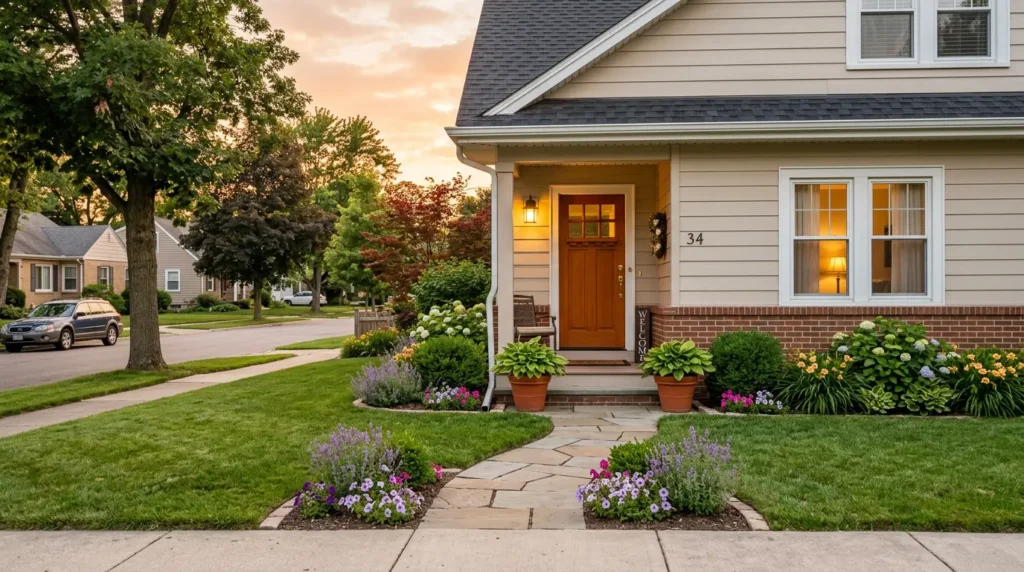
Conclusion: Your Front Yard Landscaping Journey Starts Today
There is no single perfect front yard, just as there is no single correct way to garden — there is only your yard, your climate, your aesthetic sensibility, and the particular joy you are trying to create and sustain in that specific patch of the world. The front yard landscaping ideas gathered in this guide are not a prescription but a toolkit, a collection of principles, techniques, and inspirations that you can adapt, combine, and make your own in whatever way feels most aligned with who you are and what you love.
What every beautiful front yard shares, regardless of its style, its size, or the plants it contains, is intention — the evidence of someone who has thought carefully about what they wanted to create, who has prepared their soil with care, chosen their plants with knowledge, watered with patience, and tended with attention through the seasons. That intention, more than any particular design trend or plant selection, is what transforms a strip of ground between a door and a street into something that people slow down to look at — something that makes the neighbourhood a little more beautiful, the days a little more pleasant, and the world, in its small and essential way, a little more alive.
Start small if you need to. Improve one border, plant one specimen tree, replace one patch of lawn with a ground cover that feeds the bees. The garden rewards every step you take toward it, and there is no better time to begin than the present moment — with your hands ready, your soil waiting, and every possibility still ahead of you.
Frequently Asked Questions About Front Yard Landscaping Ideas
What are the best low-maintenance front yard landscaping ideas for beginners?
The most successful low-maintenance front yard landscaping ideas for beginners focus on three core strategies: choosing plants that are native or naturalised to your region (which require minimal watering, fertilising, and pest management once established); replacing high-maintenance lawn with drought-tolerant ground covers like Ajuga, Pachysandra, or creeping thyme; and applying a generous 5–8 cm mulch layer over all planted beds each autumn, which suppresses weeds, retains moisture, and eliminates the need for regular cultivation. With these foundations in place, even a gardening novice can maintain a beautiful, structured front yard with just a few hours of attention per month.
How much does professional front yard landscaping typically cost?
The cost of professional front yard landscaping ideas implementation varies enormously depending on the scale of the project, the region, and the plants and materials chosen. A basic planting and mulching scheme for a standard suburban front yard typically ranges from $2,000 to $6,000, while a comprehensive design that includes hard landscaping (paths, edging, driveway resurfacing), irrigation installation, and a full planting scheme with mature specimens can run from $15,000 to $50,000 or more. Many homeowners achieve excellent results with a hybrid approach — commissioning a professional design and then implementing it themselves over one to two seasons, which captures the benefit of expert planning at a fraction of the full installation cost.
Which front yard landscaping ideas add the most value to a home?
Research consistently identifies several front yard landscaping ideas as particularly effective at increasing property value. A well-maintained lawn increases value by an estimated 10–15%, while mature trees can add between 7% and 19% depending on their species, placement, and health. Structured planting near the entryway — framing the front door with symmetrical specimens, adding a defined path, and removing overgrown or outdated foundation planting — delivers a strong visual impact at relatively modest cost, often adding $10,000 or more to perceived value in real estate agent assessments. The key principle is that neatness, health, and suitability to the house’s architectural style consistently outperform elaborate or fashionable designs that feel mismatched with the property.
How do I create front yard landscaping ideas for a shady front yard?
A shaded front yard, whether caused by mature trees, a north-facing aspect, or an overshadowing fence, presents a unique but entirely manageable design challenge. The key is to embrace the conditions rather than fight them, building your plant selection around the genuinely beautiful shade-tolerant plants that most sunny gardens cannot grow: the luminous gold and blue-green hostas, the ethereal white flowers of Astrantia, the deep red persistence of Heuchera, the gentle spring performance of Epimedium and Pulmonaria. Lighter-toned flowers and variegated foliage reflect available light and prevent the garden from feeling gloomy, while strategic placement of pale-painted fences or walls can reflect light back into the deepest shadow areas.
What are the best front yard landscaping ideas for small spaces?
Small front yards benefit enormously from a few key design principles that maximise the sense of space while creating genuine beauty. Vertical gardening — using wall-trained plants, climbing roses, or espalier fruit trees against the house facade — adds planting interest without consuming precious ground space. Cohesive paving that extends the apparent scale of the property, punctuated by a single well-chosen specimen plant rather than a crowded collection, creates a calm, elegant impression. Repeating a small number of plant varieties in groups of three creates rhythm and visual coherence that makes a small space feel more considered and spacious than a miscellaneous collection of single specimens ever could.
When is the best time of year to implement front yard landscaping ideas?
Autumn — specifically from early September through to the first hard frost — is the ideal season to implement most front yard landscaping ideas, particularly those involving trees, shrubs, perennials, and bulbs. The combination of still-warm soil (which encourages root establishment) and cool air temperatures (which reduce transplant stress and water demands) gives newly planted specimens the best possible start. Spring planting is the second-best option, though it is important to wait until the soil has genuinely warmed and the risk of hard frost has passed. Summer planting of established container plants is possible but requires diligent watering support, while winter planting is best reserved for bare-root trees, hedging, and roses in mild regions only.